

The Bottom Was Not In!
Treasury Companies Get the Blame

Dear Bitcoiners,
Bitcoin just made a new low. The February crash was not the bottom, mimicking previous bear market behavior.
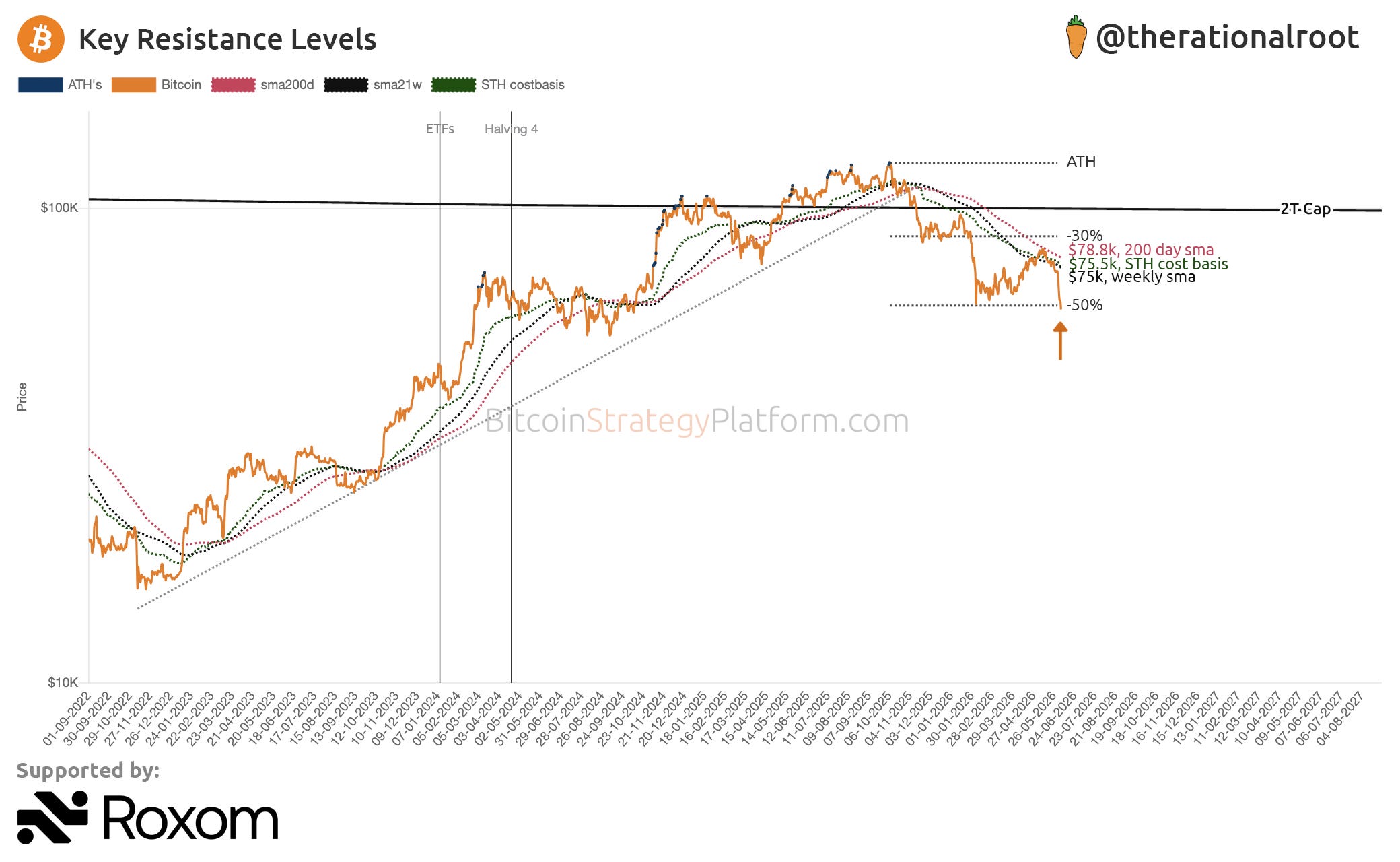
At Bitcoin Strategy, we have remained grounded and skeptical all the way through the recent extreme bullish sentiment. If you’ve been following the Bitcoin Strategy newsletters, you were prepared for what is playing out. Of course, a brutal crash like this is never fun, but we know we are in the phase of time capitulation, historically one of the best entry zones for Bitcoin.
Unlock access to the Bitcoin Strategy Platform with all premium curated live charts and indicators. Claim your 25% lifetime discount today!
This price drop surely caused frustration, after the realization that the 4-year cycle and bear market remain intact. It’s ironic to see the influencers that proclaimed we were back in a bull market now direct their anger and frustration at Saylor and Digital Credit, which has been the main source of demand in this bear market. The voices that were the loudest about being in a bull are now the loudest about Digital Credit.
I have written about how institutional flows, including treasury companies, are part of the adoption curve of Bitcoin. If you haven’t already read that newsletter, you can find it here:

I’m a Bitcoin maximalist, but I think Digital Credit will play a role in the transition to a Bitcoin standard. You can say the fiat system is garbage, and therefore all financial instruments on top of fiat are garbage. In that sense, treasury companies are also garbage. The other view is that we live in a fiat system with roughly $900 trillion of value, where everyone uses financial instruments, and treasury companies accelerate the transition of that value into Bitcoin.
The Blame of Treasury Companies
During this drop, I’ve seen some of the most ridiculous takes come by on social media. I get it, price is down and people are looking for something to blame. But the critique treasury companies received has been blown completely out of proportion.
Another 2022?
People are comparing this to the yield companies falling over in the 2022 bear market. I get the skepticism. Hearing the word ‘yield’ is an instant red flag after a 2022 bear market that was based on a cascade of opaque yield companies falling over.
But guess what, unlike 2022, transparent treasury companies have remained the main source of demand.
👉 Key insight: 2022 was opaque yield and sell pressure. 2026 is transparent yield and buy pressure. The complete opposite.
Never Sell Your Bitcoin
Strategy selling 32 Bitcoin was supposedly the trigger. This had absolutely nothing to do with the drawdown. The sale happened before the drawdown, when sentiment was still bullish, to prepare the market that a potential sell is possible when it is accretive to shareholders or for a good reason, for example during the deepest phase of a bear market.
The main reason for this sale, as I understand it, was to prove Bitcoin is liquid. Essentially, a requirement in the process of eventual S&P 500 inclusion.
👉 Key insight: Rating agencies are rating the value of Strategy’s Bitcoin at zero. The reason is that never selling Bitcoin is seen as a risk. Strategy made a small sale to prove to the agencies that Bitcoin is liquid and that they will sell if it is in the best interest of shareholders. I look at this as a requirement for S&P 500 inclusion.
Digital Credit as Medium of Exchange
You might have seen the video where Jeff Walton gets portrayed as an enemy of Bitcoin for introducing the idea of using Digital Credit as a medium of exchange. Skeptics portray Digital Credit as a shitcoin, as in: “Buy my Digital Credit instead of Bitcoin.”
The reality is that Bitcoin generally is too volatile to use as a medium of exchange, unless you use spend and replace. For that same reason, stablecoins have been much more popular than Bitcoin in countries like Argentina with high inflation. A volatile asset is simply not practical as a medium of exchange.
Eventually, when more and more capital flows into Bitcoin, its volatility will drop and it will become more practical as a medium of exchange. However, this process might take decades to unfold. Bitcoin adoption will happen first as a Store of Value (SoV), then Medium of Exchange (MoE), and lastly Unit of Account (UoA), in that order. We are currently in the SoV phase.
Digital Credit strips Bitcoin of its volatility. This is not competition for Bitcoin, it is competition for holding dollars and stablecoins.
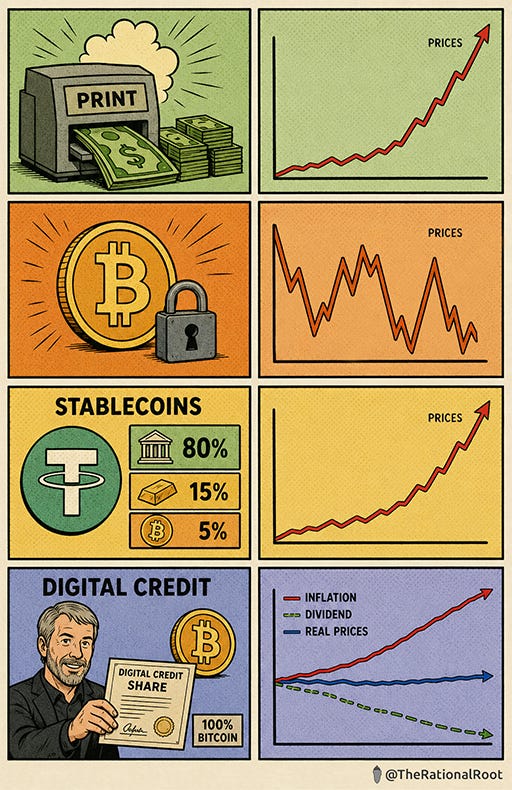
I get it, I would also prefer to see everyone doing Bitcoin-only and self-custody. But the reality is that we live in a fiat system with lots of value locked by rules and regulation. Treasury companies provide a gateway into Bitcoin. Using fiat structures, they provide a bridge for trapped and low-volatility-seeking capital to flow into Bitcoin. Would you rather have people fund governments by buying dollars, stablecoins, and U.S. Treasuries?
