

The Adoption Curve of Bitcoin
Bitcoin 2026: Las Vegas

Dear Bitcoiners,
The make-or-break moment for Bitcoin continues. Over the past week, Bitcoin has been sitting right below the STH cost basis (live chart available). We’ve been covering this level in the past two newsletters, which you can find here.
Bitcoin Las Vegas
The Bitcoin conference, taking place in the pinnacle of fiat culture, Las Vegas, was truly amazing. Speakers like SEC Chair Paul Atkins, FBI Director Kash Patel, and Eric Trump talking about Bitcoin would have been unthinkable only a few years ago.
This conference was a great mix of Bitcoin developers and institutional players. Bitcoin is for everyone. That also includes politicians and the FBI director. Powerful people having an interest in Bitcoin shows that Bitcoin is winning and is on its path toward hyperbitcoinization. I’ll explain further below why we should welcome politicians and institutions.
Unlock access to the Bitcoin Strategy Platform with all premium curated live charts and indicators. Claim your 25% lifetime discount today!
Is This the Bitcoin Supercycle or Is the Four-Year Pattern Still Intact?
I had a panel with Michael Terpin, Matt Crosby, and Shyan Hussain on the Enterprise stage about Bitcoin’s super/four-year cycle. It was recorded and should become available on the Bitcoin Magazine channel.
The general consensus of the panel was that Bitcoin has not yet broken out of the 4-year cycle. It should be bottoming within the next six months at most. And if there ever was a time for things to be different, it would be this time, as there have been structural differences regarding institutional flows compared to previous cycles.
An important point I made, but didn’t get to explain in full detail during the panel, is about what these institutional flows represent and the adoption curve of Bitcoin.
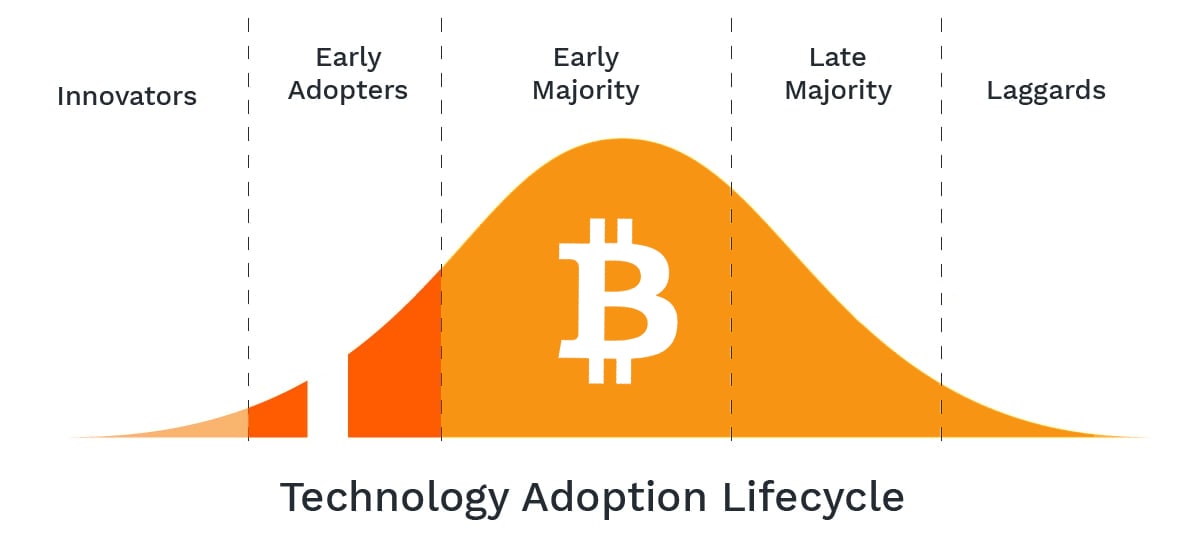
The adoption curve of a new technology starts with the innovators & early adopters, followed by the early majority and late majority.
Within Bitcoin, the early adopters are the people with a sufficiently open mind to understand its value proposition and the willingness to do the proof of work. These people have been coming in over the past cycles.
In each cycle, from 2011, 2013, 2017, and 2021, we saw a new influx of early adopters and experienced hype-driven retail cycles. The 2025 cycle, however, has been the least retail-driven cycle and has been much more about institutional flows.
What changed?
The cohort of early adopters has become saturated. The early adopters who were willing to do the work are already in Bitcoin. They had 15 years to front-run institutions. They had four hype-driven cycles to hear about Bitcoin. The majority of people, as displayed in the chart above, do not fall into the early adopter category.
So how does the majority of people come into the space?
You might have guessed it: through institutional flows.
Bitcoin is 17 years old, but the institutional gateways have only existed for two years. These gateways are ETFs and treasury companies.
The early majority does not have the time and mindspace to learn about Bitcoin. They get an allocation because their financial adviser recommends one. They come in because their pension fund starts allocating to Bitcoin, as advised by institutions like BlackRock.
We are currently only two years into institutional gateways being available, and this is the beginning of the early majority coming to Bitcoin. They would not come if it wasn’t for these institutional flows.
There will always be some retail adoption each cycle, but we are past the early adopter phase. Instead of full retail-driven cycles we’ll continue with much more structural institutional flows.
Wrap-Up
I hope you now understand why we need to welcome institutional flows, and why having politicians and the FBI director speak at a Bitcoin conference matters. They help create clear rules and regulations, like the CLARITY Act and MiCA, which are needed to pull in the majority.
Let me know what you think in the comments section. 👊 🧡
Until next week! 🫡
-Root
Bitcoin is for everyone.
We’re getting close to a breakout, but I agree not there yet.